Miami-Dade County · 24/7
Ignition Repair & Replacement in Miami
Keys stuck, ignition won't turn, fixed at the curb.
Up-front pricing · Damage-free first · Mobile units county-wide
Keys stuck, ignition won't turn, fixed at the curb.
An ignition problem and a key problem feel identical from the driver's seat, and separating them is most of the work. The key will not go in. The key goes in and will not turn. The key turns partway and stops. The key turns and nothing happens. The key turns, the engine cranks and dies. Each of those points at a different component, and three of them are not ignition cylinder faults at all. Replacing a cylinder to fix an immobilizer problem is expensive and does not work.
24/7 Locksmith Miami repairs and replaces ignition lock cylinders across Miami-Dade, at the vehicle, because a car with a failed ignition is a car that will not move. In practice that means working in driveways across Kendall, Pinecrest and Palmetto Bay, on swales in Hialeah and Little Havana, in tower garages in Brickell and Aventura, in strip centre lots along Bird Road and West 49th Street, and in truck courts in Doral and Medley on work vehicles that have to be back in service.
This page covers what an ignition lock cylinder actually is, how the wafer stack wears, the difference between the cylinder and the electrical switch behind it, how steering locks and immobilizer antenna rings complicate the job, when rebuilding beats replacing, what the work involves on a modern column, and what drives the cost. Call (786) 539-3980 with the year, make, model and trim, and a precise description of what the key does.
The part you put a key into is a lock cylinder, and on most vehicles it uses wafer tumblers rather than the pin tumblers found in building hardware. Wafers are flat sprung plates that sit across the plug and drop into a groove in the housing, blocking rotation until the correct key lifts each one flush with the plug's surface. Behind the cylinder sits a cam, a rack or an actuator rod that transmits rotation to the electrical ignition switch, and on many vehicles to the steering lock bolt as well.
That separation matters because they fail independently. The cylinder can be worn out while the electrical switch is perfect, and the switch can be dead while the cylinder turns beautifully. On a column mounted assembly, the cylinder is typically retained by a spring loaded pin accessed through a small hole after the shrouds come off, and the switch is a separate module further down the column or on its side. Diagnosing which half has failed determines whether the repair is a lock job or an electrical job.
The ignition is the most heavily cycled lock on a vehicle, operated multiple times a day for years, always with the same key, and usually with a keyring hanging from it applying constant downward load. Wafers wear at their contact edges, springs weaken and take a set, and the plug wears in the housing. The key itself wears at the same time, its cuts gradually rounding, so key and lock drift together and the fault stays invisible until a fresh key from the same code refuses to work.
The warning signs are consistent and people ignore them for months. The key needs to be wiggled to turn. It works in one position but not another. It has to be pushed in slightly harder than it used to. It turns more easily with the key partially withdrawn, which is the strongest single indicator of a worn wafer stack. Heavy keyrings accelerate all of this, and in this climate salt air and beach sand accelerate it further, particularly on vehicles kept near the water in Key Biscayne, Surfside or Miami Beach.
Start with the free ones. On most automatics the shifter must be fully in park, and a shifter resting just short of the detent will block the ignition through the interlock. Steering wheel load is the other classic: if the wheels were turned against a kerb, which happens constantly on the narrow parked streets of Little Havana, Hialeah and Coral Way, the steering lock bolt binds under side load and the cylinder will not rotate. Rocking the wheel firmly left and right while turning the key releases it more often than not.
If those are cleared, the suspects are mechanical. A worn wafer stack that no longer aligns. Debris packed into the keyway, which in this county is often sand, or in work vehicles, dust and grit. A bent or damaged key that is not lifting the wafers correctly. A broken retainer, cam or rack behind the cylinder, where the key turns freely but nothing downstream moves. Or a seized plug where corrosion has effectively welded the assembly. Each of those needs different handling and they are distinguishable by feel.
If the key rotates normally and the engine cranks but does not run, the ignition cylinder is almost certainly fine and the problem lies elsewhere. The most common lock related cause is the immobilizer refusing to authorize. A security or immobilizer telltale on the cluster is the tell. The possible faults are a failed transponder chip in the key head, a damaged antenna ring around the ignition cylinder, wiring to that ring, or a module fault. The antenna ring is frequently damaged during careless cylinder work, which is one argument for doing it properly.
It is equally possible that the fault is nothing to do with keys or locks at all. Fuel delivery, spark, a crank position sensor, a failed relay or a dead fuel pump all produce a vehicle that cranks and does not start. A locksmith can rule the lock and immobilizer side in or out quickly, and when the answer is that the problem is elsewhere, the right outcome is being told so rather than being sold an ignition. Knowing where the boundary sits is part of competence.
Rebuilding means removing the cylinder, disassembling the plug, replacing worn wafers and springs, cleaning the housing and reassembling it keyed to your existing key. The advantage is significant: one key continues to operate doors, trunk and ignition, which is how the vehicle left the factory and how it should stay. It suits vehicles where the housing, cam and rack are sound and only the wear items have gone, which is the majority of worn ignition complaints.
Replacement becomes necessary when the housing is cracked, the cam or rack is broken, the plug has seized past recovery, or the assembly was damaged by a forced entry or theft attempt. A replacement cylinder arrives keyed to its own new key, so either it gets rekeyed to match your existing key, or you accept carrying two keys, or the door and trunk cylinders get rekeyed to match the new one. On many modern vehicles the replacement also has to be reconciled with the immobilizer, which is more work than the mechanical part.
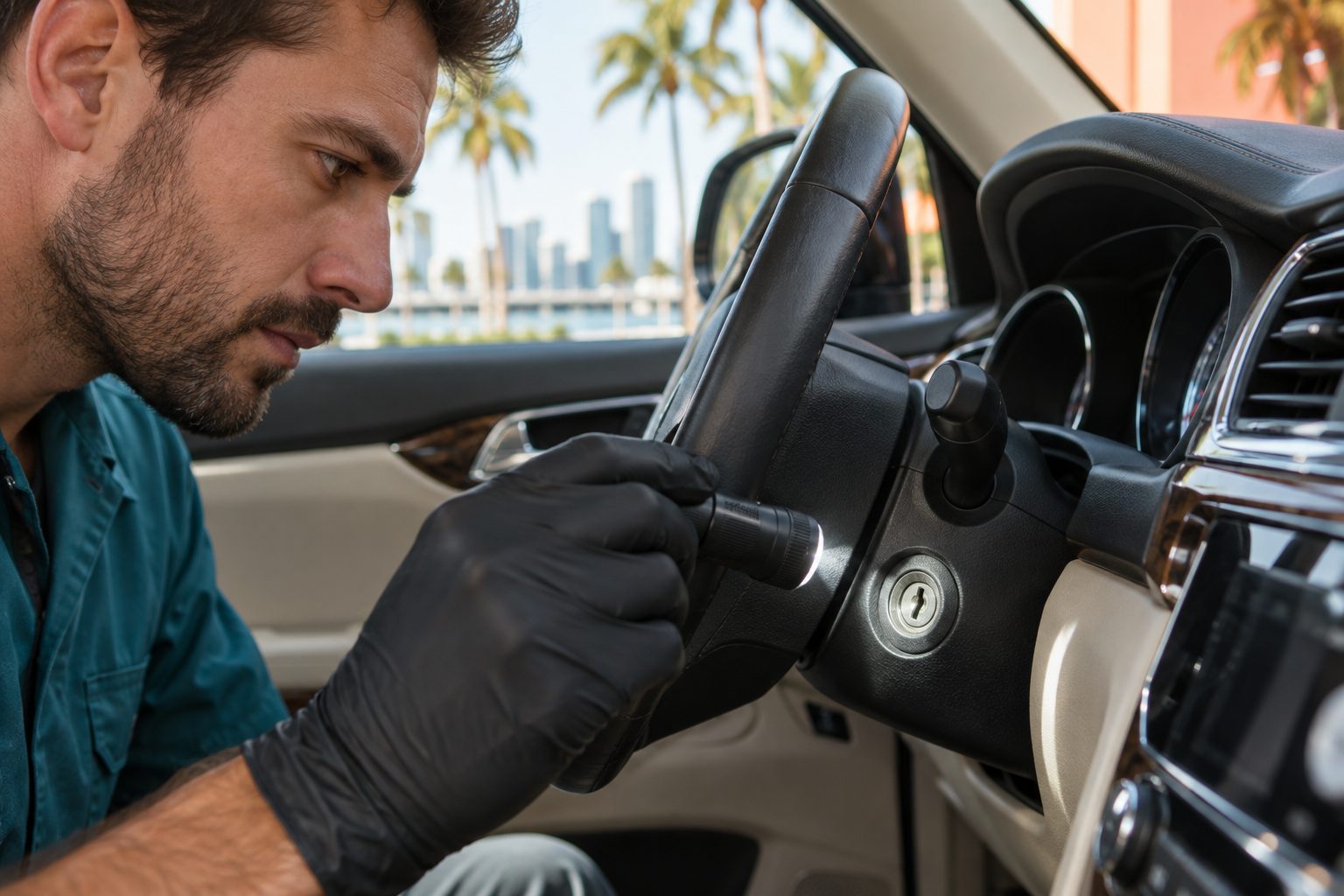
On a column mounted ignition the job is not a five minute part swap. The upper and lower shrouds have to come off, which on many vehicles means removing the lower dash trim, the knee bolster or the steering wheel tilt lever first. Airbag wiring and the clockspring live in this area and are not to be disturbed carelessly. The cylinder is typically released by depressing a spring loaded retaining pin through a small access hole with the key turned to a specific position, which is an exact sequence rather than a general technique.
The steering lock bolt is the complication. It engages a slot or a collar on the steering shaft and is driven by the same cam that operates the switch. If the bolt has jammed under load, or its spring or actuator has broken, the symptom looks exactly like a failed ignition cylinder while the cylinder is fine. Freeing and repairing a jammed steering lock is a distinct task, and on some vehicles it requires column disassembly well beyond what an ignition cylinder change involves.
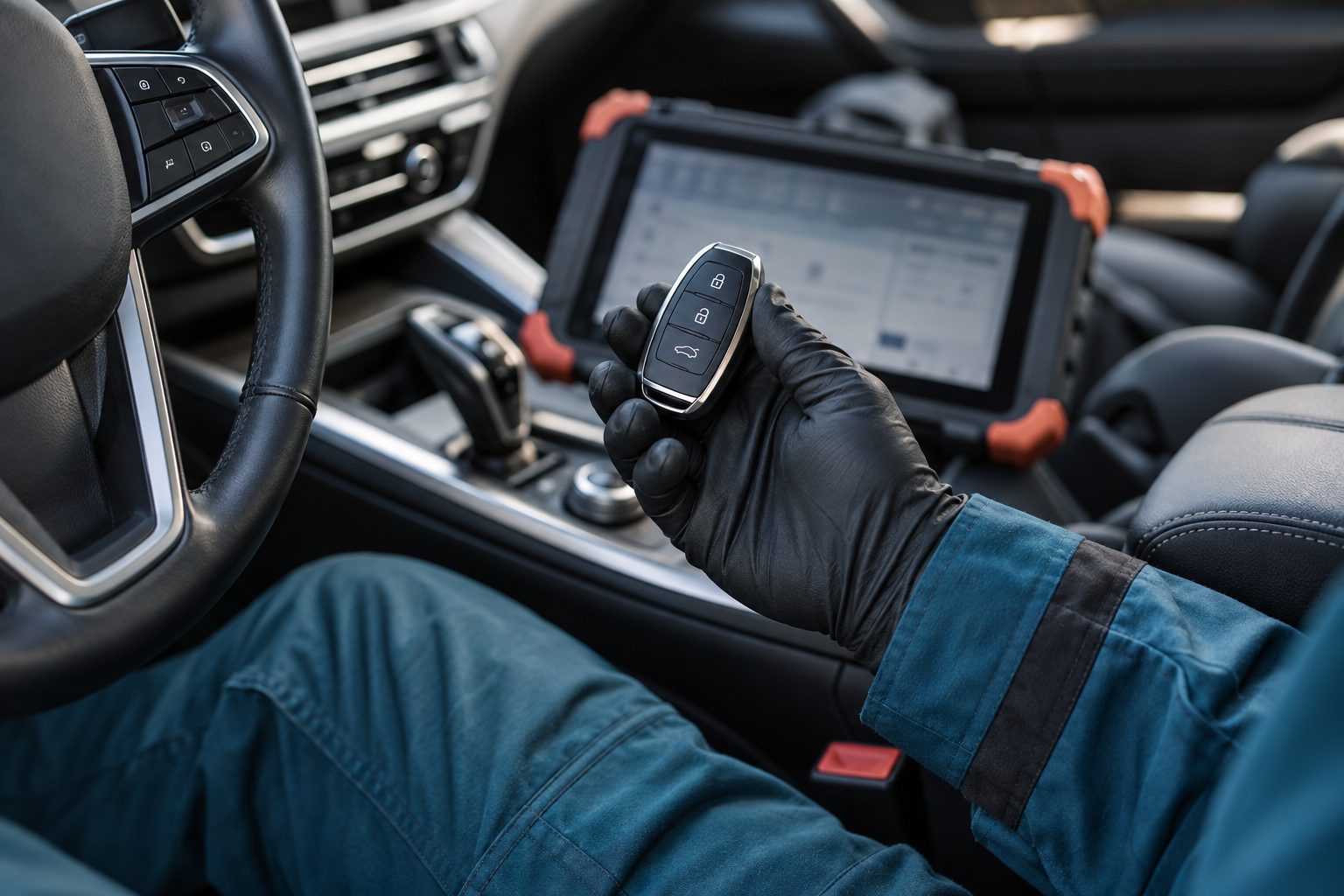
Vehicles with a start button have no ignition lock cylinder at all in the traditional sense. The start button is a switch, the authorisation comes from the proximity fob through the immobilizer, and the steering lock, where fitted, is an electronic steering column lock actuator driven by a motor rather than by a cam. The failure modes are therefore completely different: a failed start button, a failed brake pedal switch that prevents the start condition, a fob not being detected, or a column lock actuator that will not release.
A jammed electronic column lock is the one that most resembles a classic ignition failure, because the wheel stays locked and the vehicle will not start. It is not a lock cylinder repair. Diagnosis usually involves fault codes from the relevant module, and the fix is an actuator or a wiring repair. What a locksmith can do usefully here is establish whether the fob and immobilizer side is authorising correctly, which cleanly separates a credential problem from a mechanical or electrical column problem.
A key snapped off in the ignition is a specific job. The fragment is removed with spiral or hook extractors working the blade's own cuts, ideally with a scope and light, and the goal is to bring it out without gouging the wafers or breaking an extractor tip inside the plug. The far more important question is why it broke, because keys break when they are worn thin or when the lock is binding, which means the extraction is treating a symptom and the cylinder usually needs attention as well.
Forced ignitions are a different situation. An attempted theft that punched or twisted the cylinder leaves damage to the plug, the housing, the cam and frequently the steering lock and the immobilizer antenna ring. That is a replacement rather than a rebuild, and it often extends into column work. Where a theft attempt is involved, involve police before repair so the damage is documented, both for the report and for any insurance claim, and expect the scope to be larger than a simple cylinder change.
The main variables are whether the repair is a rebuild or a replacement, how much column disassembly the specific vehicle requires to reach the cylinder, whether the new or rebuilt cylinder has to be keyed to your existing key, and whether the immobilizer has to be addressed afterward. A vehicle where the shrouds come off in two minutes and the cylinder releases with a pin is a straightforward job. A vehicle requiring wheel removal, bolster removal and careful work around airbag wiring is not.
Then there is whether a working key exists. Rebuilding a cylinder and keying it to an existing key is one job. Producing a new key, keying the cylinder to it and enrolling it with the immobilizer is several. Add the service call across the county and the hour of day. The honest approach is to diagnose first and quote against the actual fault, because quoting an ignition replacement for what turns out to be a jammed steering lock is a way to overcharge for nothing.
Try the free diagnostics first and report what happens. With the vehicle in park, rock the steering wheel firmly left and right while applying steady turning pressure to the key, since a steering lock under load is the single most common cause of a key that will not turn. Try your spare key, because a worn key on a worn lock is a pairing and a different key sometimes works. Note exactly at what point the key stops, and whether it feels gritty, springy or completely solid.
This is the wrong call in several situations. If the engine cranks strongly and simply will not run, and there is no security telltale on the cluster, the fault is likely fuel, spark or a sensor, and that is a mechanic's job. If nothing at all happens when the key turns, including no dash lights, look at the battery first. If the vehicle was broken into or a theft was attempted, involve police before repair. And if the key itself is visibly worn, a new key from code may fix the whole complaint.
This service is available across all of Miami-Dade County, see our full coverage map or just call and tell dispatch where you are.
One number, any hour: a live dispatcher and a mobile technician near you.