Miami-Dade County · 24/7
Car Lockout Service in Miami
Locked out of your car? We open it without damage.
Up-front pricing · Damage-free first · Mobile units county-wide

Locked out of your car? We open it without damage.
A car lockout looks like the simplest job a locksmith does and is one of the easiest to do badly. The car is right there, the keys are visible on the seat, and the whole thing is over in a few minutes when it goes correctly. What separates a clean opening from an expensive one is knowledge of what sits inside the specific door being worked on, because a modern vehicle door is a crowded box containing a side curtain airbag along the roof rail, a window regulator, speaker wiring, a side impact sensor and often a door control module.
24/7 Locksmith Miami handles vehicle lockouts across Miami-Dade, and the county produces an unusually wide range of them. A car on a residential tower's fourth parking level in Brickell or Aventura, behind a gate that reads only a resident transponder. A car in the swale in front of a Hialeah house. A car in a surface lot off Calle Ocho, in a Dadeland garage, in a truck court on NW 25th Street in Doral, or on an unpaved approach at a packing house south of Homestead. The opening is the same. Reaching it is not.
This page covers what actually happens during a vehicle opening: the tools, the method, the risk points, the vehicles that do not behave the way people assume, and what you can do in the minutes before a technician arrives to make the call shorter. Call (786) 539-3980 with the year, make, model, trim and your precise location, and most of the guesswork disappears before anyone sets out.
Below the glass, the door cavity holds the window regulator and its motor, the glass run channels, speaker wiring, the latch assembly with its cable or rod linkages to the inside and outside handles, a side impact sensor on most vehicles, and on many cars a door control module handling window, mirror and lock functions. Above and around the opening, along the roof rail, runs the side curtain airbag and its harness on essentially every vehicle built in the last two decades.
None of that is visible from outside, which is why an opening on a car the technician has never seen before starts with identifying the exact year, make, model and trim rather than with a tool. The layout differs between a sedan and a coupe of the same model, between trims with and without a certain option package, and across model year refreshes. A long reach tool pushed blindly into a cavity can snag a harness, displace a linkage, damage the regulator or foul against an airbag component, and all of those cost far more than the lockout did.
The standard approach creates a controlled gap at a door corner and reaches the interior control through it. A plastic or composite wedge starts the gap, chosen so nothing metallic ever touches paint. An inflatable air bladder then goes into that gap and is inflated slowly, spreading load across a broad area rather than concentrating it at a point the way a pry bar would. The gap needed is small, measured in fractions of an inch at the top corner, and the frame flexes within its elastic range rather than taking a set.
With the gap held, a coated long reach tool enters and is routed to the target: the interior door handle, the electric unlock button on the armrest, the lock stem on older vehicles, or occasionally the key fob itself sitting on a seat within reach. The tool is manipulated under direct visual observation through the gap, not by feel. On many current vehicles the fastest and safest target is the unlock button, because it needs only a push rather than the pull and hold sequence some interior handles require.
Frameless window designs, common on coupes and on many European sedans that are everywhere in Brickell, Aventura, Key Biscayne and Coral Gables garages, have no metal frame around the glass. The pane drops a few millimetres when the handle is pulled and reseats against a rubber channel when the door closes. Wedging against frameless glass as though it were a framed door either ruins the seal, stresses the pane or does both, and the correct approach on those vehicles is different in both entry point and technique.
Fixed quarter glass at the front corner of the door is the other trap. On vehicles with a small triangular pane there, wedging at what looks like the natural corner can crack it, and the correct entry is elsewhere along the top edge. Doors with heavy frame stiffening, doors with the latch on the wrong side for the intended tool path, and doors where the airbag harness runs low all push the entry point around. Choosing the corner is the actual expertise, and it is model specific, not general.
Long reach tools come in several geometries because interior controls do. A simple hook works on a lock stem or a pull style handle. An angled tip with a rubber or nylon end presses a flush mounted unlock button without slipping. A wire tool with an adjustable bend navigates around a B pillar or a headrest. All of them are coated or sleeved along their length so that if the tool contacts a door card, trim or glass, it does not mark it.
Some interior controls resist this. Vehicles where the interior handle must be pulled twice, or pulled and held while a separate action occurs, complicate the reach. Child safety locks on rear doors change what the rear interior handle does. Certain trims place the unlock control low on the door card or on the centre console, out of reach from the top corner entirely, which forces a different approach. When the interior control cannot be reached safely, the honest answer may be that a key has to be made instead, and that gets said before anything is forced.
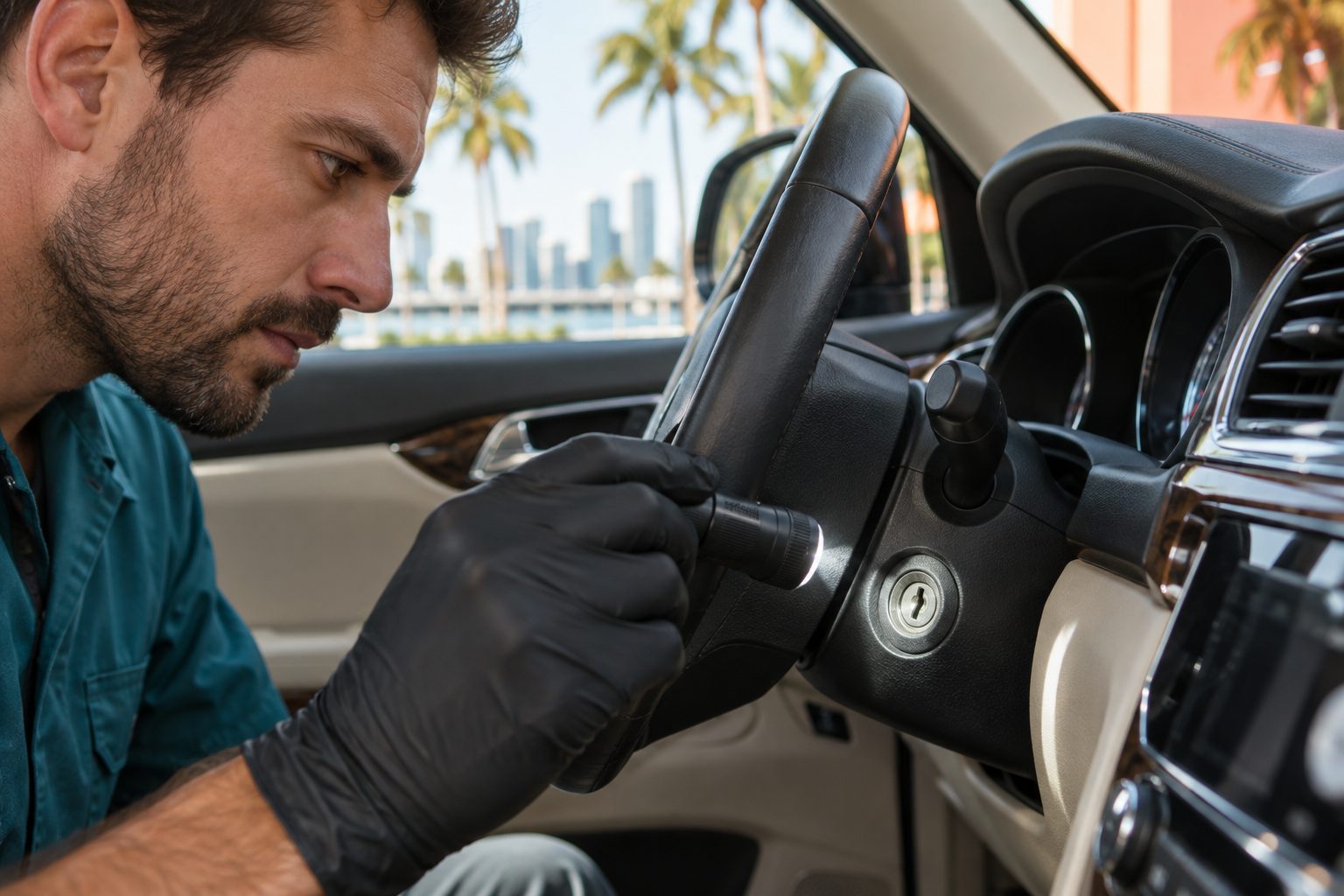
A growing share of vehicles have no exterior key cylinder on the driver's door at all, or have one concealed behind a cap on the handle that most owners have never removed. The mechanical bypass people assume exists on every car does not exist on these, and entry has to be through the door gap to the interior control. Some manufacturers put the only remaining cylinder on the passenger side, which changes which door gets worked on and sometimes changes the entry corner along with it.
Push to start vehicles introduce their own lockout pattern. Many lock automatically when the proximity fob moves away from the vehicle, which is precisely what happens when a driver walks to a garage elevator in a Brickell or Aventura tower with the fob still sitting in the centre console. Others lock on a timer or when the doors are closed with the vehicle off. The owner frequently did not press anything, which is why the situation feels inexplicable. It is normal behaviour, and it is worth knowing your vehicle does it.
This comes up constantly after groceries, beach gear or luggage, and it is usually the same job with one extra step rather than a separate problem. On most sedans the fastest route is to open a door by the normal method, then fold the rear seat or use the ski pass through to reach into the trunk from inside the cabin. On SUVs and hatchbacks the rear compartment is usually continuous with the cabin, so once a door is open the keys are simply reachable.
Where the rear seat does not fold and there is no pass through, the trunk lock or the interior trunk release becomes the target. Many vehicles have an emergency trunk release handle inside the trunk itself, which helps nobody standing outside, and some have a valet lockout that disables the interior release entirely when set. If your keys are in the trunk, say so on the phone, because it changes which tools come out and occasionally changes whether the opening is straightforward at all.
In much of the county's densest housing the car is not at a street address, it is on a numbered deck behind a gate. Brickell packs almost thirty thousand residents into 1.19 square miles with structured garages and valet dominating and almost no metered curb parking. Aventura, Sunny Isles Beach, Downtown, Edgewater and the Dadeland towers are the same picture. Many of those residential garages admit vehicles only by resident transponder, with no ticket dispenser and no visitor lane.
That makes access, not the lock, the slow part. The workable solutions are consistent: you meet the technician at the ramp and ride in, the front desk or valet opens the gate on request, or the technician parks outside and walks in with tools while you escort. Give the garage level and the nearest painted column marking, bay number or zone letter, because those markings are the real address on a deck. Send it by text while you still have signal, since coverage below grade usually disappears.
Away from the towers, the geography flips. Hialeah, Little Havana, Westchester, Flagami and most of Kendall put cars in short driveways and on the swale, the grass right of way strip, on residential streets that are often narrow and fully parked. Those calls are mechanically simple and logistically tight: there may be no room to open a door fully, and a neighbouring vehicle eighteen inches away changes where a technician can stand.
Surface lots carry their own problem, which is finding you. A strip centre lot along West 49th Street, Kendall Drive or Bird Road can hold hundreds of vehicles and has no meaningful address beyond the plaza name. Give the anchor store you are parked in front of, the row, and the colour, make and model. Wynwood and the Design District add late night metered curb parking where enforcement runs long, and Doral and Medley add fenced truck courts that need a gate code or a guard cleared before anyone reaches the vehicle.
Check the other doors and the tailgate first, including the ones you never use, because a surprising share of lockouts end there. If your vehicle has a manufacturer app with remote unlock, try it, and if you have a second fob at home with someone who can bring it, that is often faster than any service call. Look at whether the windows are fully up, note whether the vehicle is running, and if it is, say so, because a running locked car is handled with more urgency.
Then get your documentation in order, because the opening does not happen without it. Photo ID plus registration or insurance is the normal standard, and registration is commonly in the glovebox, which means it gets verified right after the door opens rather than before. In a residential garage the building can usually help: a front desk confirmation, a resident decal, an assigned space number matching management's records or a valet claim ticket all serve the same purpose. Expect to be asked. It is the same check protecting your car from someone else.
The cost drivers on a vehicle opening are the service call across a county this large, the time of day, how difficult the specific vehicle is to open safely, and how much work reaching the vehicle takes. A car in a public surface lot at noon and a car on a lower deck behind a resident only gate at three in the morning are not the same job even in the same car. Vehicles requiring a specialised approach because of frameless glass, an unusual interior control or a missing exterior cylinder sit at the higher end.
A lockout call is the wrong call in a few situations. If a child or a pet is shut inside, call 911 first, because fire rescue and police are closer to most addresses and are authorized to act immediately. If the key is genuinely lost rather than locked inside, opening the door solves nothing and the job is key origination instead. If a key snapped off in the door lock, that is extraction. And if the vehicle was broken into, the police report comes before any repair work begins.
Choose your neighborhood for local details: