Miami-Dade County · 24/7
Car Key Replacement in Miami
Lost car keys made on-site, most makes and models.
Up-front pricing · Damage-free first · Mobile units county-wide

Lost car keys made on-site, most makes and models.
Replacing a car key used to mean cutting a piece of brass. On anything built since the mid 1990s it means two separate jobs that both have to succeed: producing a blade that operates the mechanical lock, and producing an electronic credential that the vehicle's immobilizer will accept. A perfectly cut key with an unprogrammed chip will turn the ignition and the engine will crank and immediately die, which is the single most common source of confusion in this entire service category.
24/7 Locksmith Miami originates and programs vehicle keys across Miami-Dade, on site, wherever the vehicle happens to be sitting: a residential tower garage in Brickell or Aventura, a swale in Hialeah, a strip centre lot on West 49th Street or Kendall Drive, a truck court in Doral or Medley, a driveway in Palmetto Bay, an unpaved yard outside Homestead. The advantage of doing it at the vehicle is obvious once the vehicle will not move, because the alternative is a tow to somewhere else before the work can even begin.
This page explains what actually happens: how cutting codes are derived, the difference between edge cut and high security blades, the four generations of transponder technology still on the road here, what an add key job is versus an all keys lost origination, when the immobilizer's key list has to be erased, what drives cost, and when a locksmith is the wrong place to take the problem. Call (786) 539-3980 with year, make, model and trim.
The mechanical half is the blade, which has to match the wafer or pin stack in the door cylinder and the ignition cylinder. The electronic half is the transponder, a passive chip in the key head energised by a coil around the ignition or in the antenna ring, which answers a challenge from the immobilizer. If the answer is wrong or absent, the immobilizer withholds fuel, spark or starter enable depending on the manufacturer, and the vehicle cranks without starting.
These two halves fail independently and produce different symptoms. A worn or wrongly cut blade will not enter or will not rotate, and the engine never gets the chance to try. An unprogrammed or failed transponder lets the key turn normally and then blocks the start, usually with a security or immobilizer telltale illuminating on the cluster. Proximity systems remove the blade from daily use entirely, but almost all of them retain a hidden door cylinder and an emergency insert blade for exactly the situation where the fob's battery dies.
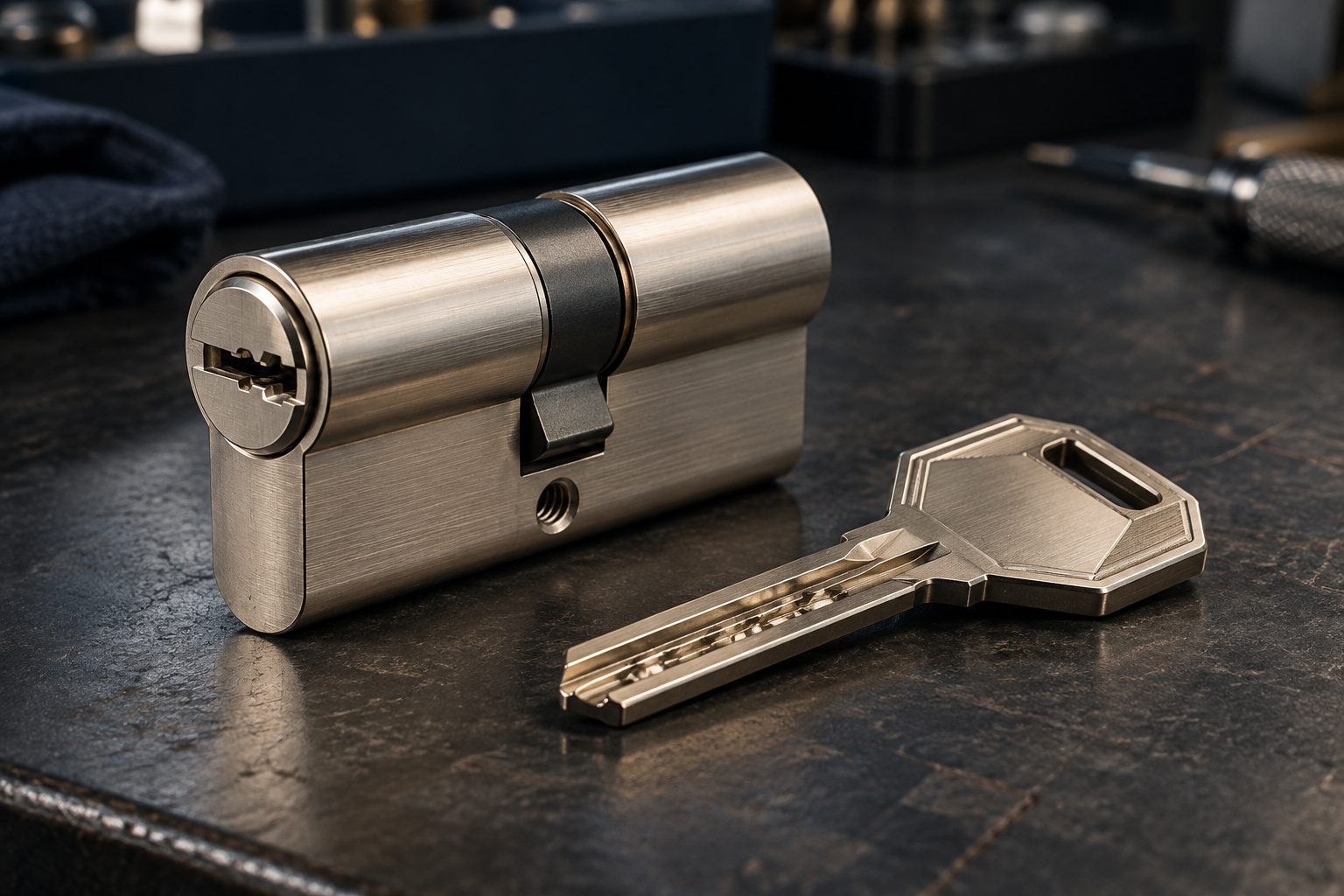
Edge cut blanks carry their cuts along the edge of the blade and are the traditional form, still used across a large share of the fleet. They can be duplicated from an existing key on a standard machine or originated by code on a code machine. High security blanks, variously called laser cut, sidewinder or internal cut, carry a milled wavy channel along the face or the side of the blade rather than notches on the edge, and they require a milling machine with the correct cutter and clamping rather than a duplicator.
The difference matters for what has to be on the service vehicle. A milling capable machine, the right cutter, the right clamp and the correct blank for the vehicle's keyway all have to be present, and blank families are specific: a blank that physically enters a keyway is not necessarily the right blank for that vehicle's code series. Proximity fobs complicate this further, because the emergency insert blade is often a small, separately cut item that still has to match the hidden door cylinder.
With a working key in hand, duplication is simple. With no key at all, the cuts have to be derived. There are several legitimate routes. The vehicle identification number can yield a key code through a code source for some manufacturers, and that code translates directly into cuts. The door lock cylinder can be removed and decoded by reading its wafer stack, which gives the door cuts, from which the full blade can usually be derived. On some vehicles the immobilizer or another module holds data that yields the code.
Each route has limits. Code by VIN is unavailable or restricted for a number of manufacturers, particularly on newer vehicles where the code channel is dealer controlled. Decoding a cylinder requires removing it, which on some door assemblies is quick and on others involves interior trim removal. Reading a module requires the right tooling and sometimes physical access to the module. Part of the intake conversation is establishing which of these routes is available for your specific vehicle before anyone commits to a price or a timeline.
The oldest keys on the road here carry no electronics at all, a plain blade on an older truck or work vehicle, and those are simply cut. Fixed code transponders arrived in the mid 1990s: the chip answers the coil's challenge with a static identifier that never changes. Rolling code systems followed, where the response changes on every authentication cycle using a shared counter and algorithm, so a captured response is worthless the moment it is used.
Current systems use encrypted bidirectional communication, where the immobilizer and the key run a cryptographic exchange based on a shared secret, and the key proves it knows the secret without ever transmitting it. Proximity systems add a low frequency wakeup field and a radio frequency response, letting the vehicle detect the fob's presence and location without any physical contact. Each generation changed what tooling can enrol a key, which is why capability is model and year specific rather than general, and why the intake question is so precise.
If you still have one working key, the job is an add key. The vehicle is put into a learn or programming state, usually through a defined sequence involving the existing key, and the new transponder is enrolled alongside the existing ones. It is quick, low risk, and every key that worked before still works afterward. This is why keeping a spare somewhere sensible is genuinely worth doing, and why the very first intake question is whether a working key exists anywhere, including in a drawer at home or with a family member.
With no working key, the job becomes an all keys lost origination and it is a materially larger piece of work. The cutting code has to be derived. The immobilizer has to be persuaded to accept a key from a locked out state, which on many vehicles means accessing a security PIN or seed, sometimes reading a module directly, and sometimes waiting out a manufacturer imposed security delay measured in minutes before the system will accept an enrolment. The difference in time, tooling and risk between the two is substantial.
On many vehicles, recovering from an all keys lost state requires erasing the immobilizer's list of enrolled keys before new keys can be written. The module cannot simply add a key to a list it can no longer authenticate against, so it starts a fresh list. The consequence is immediate and irreversible: every key previously programmed to that vehicle stops working at that moment, including a spare sitting in a kitchen drawer that nobody mentioned during the call.
This is not a technician's preference and it is not avoidable by choosing a different tool. It is how those systems are designed to recover. It is also why we ask insistently at intake whether any key exists anywhere, because if one does, retrieving it is faster, cheaper and less disruptive than originating from nothing. It has a security upside worth noting: after an erasure, any key a previous owner, a former partner or a valet quietly kept is dead. For a used vehicle purchase, that is often the right thing to do deliberately.
The whole point of mobile key origination is that the vehicle does not have to move, and in this county the vehicle frequently cannot. A car on the fourth level of a residential garage in Brickell, Aventura or Dadeland is behind a gate that reads only a resident transponder, and towing it is a genuine ordeal. A vehicle in a fenced truck court in Doral or Medley is behind a gate code or a guard. A work truck on an agricultural property south of Homestead is at the end of an unpaved approach.
What the site needs to provide is modest but real: enough room to work at the driver's door and the ignition, reasonable light or the ability to work under our own, and a place the service vehicle can actually stand. Programming sessions draw on the vehicle battery, so a car that has been sitting with a weak battery may need a boost before anything can be enrolled, and a battery that dies mid session is a genuine problem. If the vehicle has been sitting for weeks, mention it.
Search properly for an existing key first, because the difference between add key and all keys lost is the largest single variable in this job. Check coat pockets, gym bags, the last store you visited, the valet stand, a family member's keyring and the drawer where the dealer spare was put on delivery day and never touched again. If a spare exists anywhere reachable within a couple of hours, retrieving it usually beats originating a key from nothing on both time and cost.
Then gather the paperwork and the details. Have photo ID and the registration, insurance card, title or bill of sale available. Write down the year, make, model and trim from the registration rather than from memory, and if you can reach the door jamb sticker, note what is on it. Make sure the vehicle is reachable and that a service vehicle can stand nearby, and clear the driver's footwell and the area around the ignition. If the car has been sitting for weeks, say so, because a weak battery can stall a programming session.
Five things. Whether a working key exists, because add key and all keys lost are different jobs. The blade type, since a high security milled blank costs more than an edge cut blank and takes longer to produce. The key type, since a plain transponder key, a remote head key and a proximity fob are three different items. The programming route the manufacturer permits, since some require considerably more work than others. And the service call itself, across a county that runs from Aventura to Florida City, plus the hour.
What does not drive cost is how urgently you need it, and you should be sceptical of a quote that moves once someone is standing next to your car. A quote given on the phone against an accurate description of year, make, model, trim and key situation should hold. Where it legitimately changes is when the vehicle turns out to differ from the description, for example a trim level using a different key system, or a door cylinder that has to be removed and decoded because no code route is available.
Some manufacturers restrict key origination to dealer level tooling or to a security code obtained through a channel a third party cannot access, and on those vehicles the dealer is the correct destination. Some vehicles under warranty, or with subscription linked telematics keys, are better handled through the manufacturer for reasons that have nothing to do with capability. And if the vehicle has been reported stolen or the ownership is disputed, no locksmith should be making a key for it, which is why proof of ownership is not a formality.
There are also problems that look like key problems and are not. A vehicle that cranks and will not start may have a fuel, spark or sensor fault rather than an immobilizer fault, and a key will not fix it. A vehicle that will not crank at all is more likely a battery, starter or ignition switch electrical issue. An ignition cylinder that will not rotate with a known good key is a cylinder repair job. Diagnosing which of those you have, before making a key, is part of the work.
Choose your neighborhood for local details: