Miami-Dade County · 24/7
Safe Opening & Service in Miami
Locked-out safes opened without destroying them.
Up-front pricing · Damage-free first · Mobile units county-wide
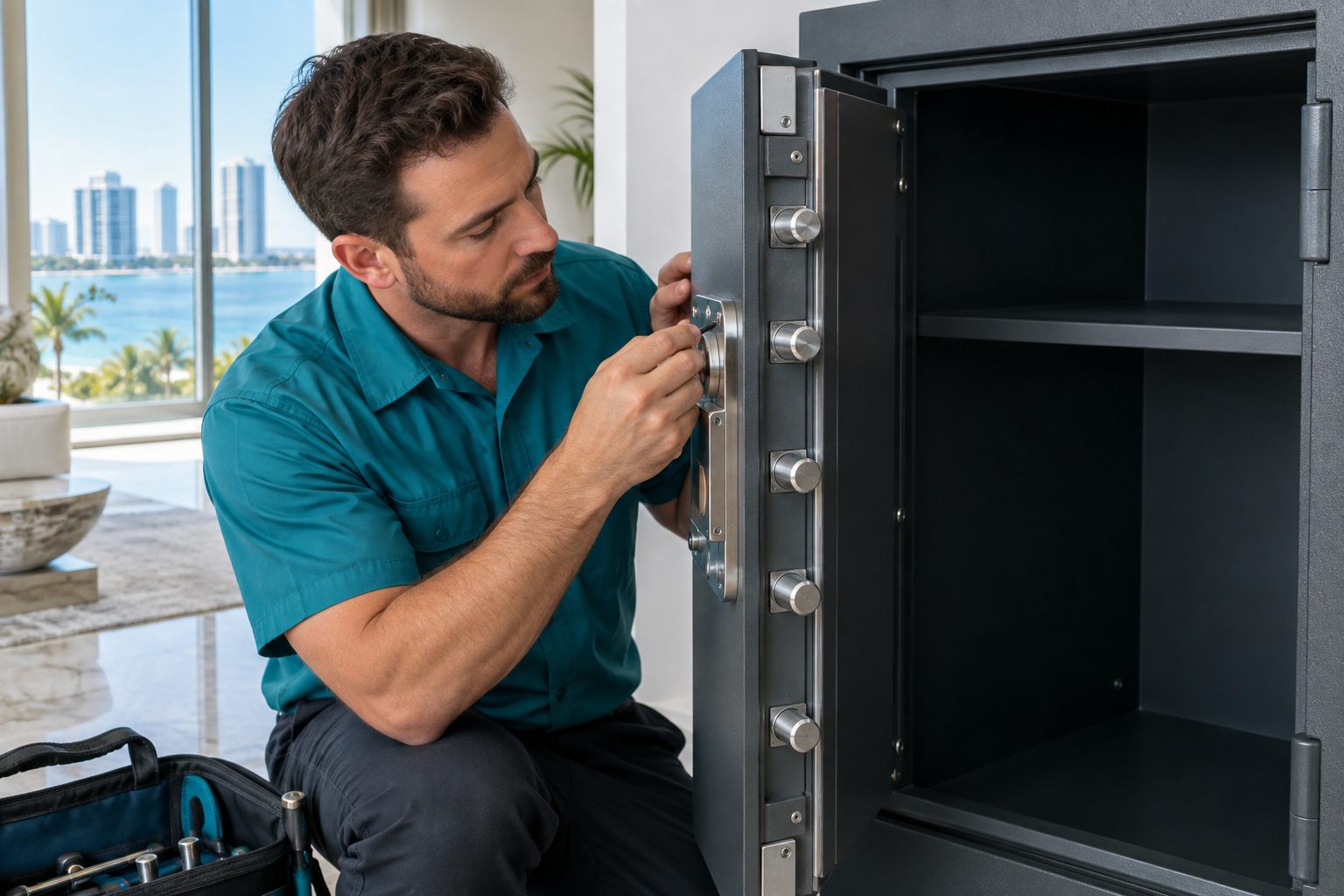
Locked-out safes opened without destroying them.
A safe that will not open is a different kind of problem from a locked door, because the container is built specifically to defeat the exact work you now need done. Everything about it, the hardplate over the lock, the relockers waiting to trigger, the boltwork, the barrier material in the walls, exists to make opening it from outside slow, loud and expensive. Doing that without destroying the container, and without triggering the traps that would turn a two hour job into a two day one, is the entire skill.
24/7 Locksmith Miami opens safes across Miami-Dade: home safes in Pinecrest, Coral Gables and Aventura condominiums, jewelry safes Downtown, floor safes under restaurant offices in Wynwood and Little Havana, gun safes in Kendall and Homestead, wall safes in older Coral Way houses, and commercial deposit and depository units in retail along West 49th Street, Bird Road and Kendall Drive. Each of those is a different container with different construction and different correct approaches.
This page covers what is actually inside a safe lock, the difference between manipulation and drilling, how relocking devices work and why they matter so much, what determines whether a safe can be opened without damage, what happens to the container afterward, and what to establish before anyone starts. Call (786) 539-3980 with the make, the model if you can find it, the lock type and what exactly happens when you try to open it.
A mechanical combination lock is a stack of wheels on a spindle inside a sealed case, each wheel carrying a gate. Turning the dial drives the wheels through drive pins, and when every gate lines up under the fence on the lever, the fence drops into the gates and the lever can retract the bolt, which releases the boltwork. The precision involved is small: a wheel a fraction of a degree out of position stops the fence dropping and the lock does not open.
An electronic lock replaces the wheel pack with a keypad, a board and a small motor or solenoid that releases a blocker. It is faster to use, allows multiple user codes and audit trails on better units, and introduces failure modes the mechanical version does not have: dead batteries, corroded battery terminals, failed solenoids, cracked keypad membranes, broken cable between keypad and lock body, and boards that fail outright. The boltwork behind either lock is usually identical, which matters when deciding how to approach the container.
Manipulation recovers a combination by reading the lock's own mechanical feedback. Contact points, the positions where the lever nose contacts the drive cam, shift almost imperceptibly as wheel gates pass under the fence, and by charting those shifts across the dial an operator can narrow each wheel's gate position and progressively derive the combination. It requires a mechanical lock in reasonable condition, quiet, patience and a lot of experience, and it leaves the container completely untouched.
It is not a universal answer. Electronic locks cannot be manipulated at all, because there is no mechanical feedback to read. Mechanical locks with worn or damaged wheel packs, with a broken drive cam, or with a lever spring that has failed may not produce readable feedback. Locks designed with manipulation resistant features, serrated or false gated wheels among them, resist it by design. And manipulation takes time measured in hours, which on a commercial job that needs opening now may simply be the wrong economics.
Drilling a safe is not attacking it randomly. It is placing a small scope hole at a precisely calculated point so a borescope can see the lock package and a punch or pick can operate it directly. The point is derived from the manufacturer's construction, published drill point information for that make and model, and measurement from known reference features on the door. The goal is a hole small enough to be plugged and repaired, positioned to avoid the relockers and the hardplate where possible.
Getting the model right is therefore central, and it is why the first questions are about make, model and serial rather than about what is inside. The wrong drill point on the right safe wastes hours. The right drill point on a container whose manufacturer changed construction mid production does the same. Once through, the operator may view and dial the wheel gates directly, punch the lock, or manipulate the boltwork depending on the design. Then the hole is plugged, the hardplate repaired where possible and the lock replaced.
Hardplate is a layer of hardened steel, often with embedded carbide chips, set over the lock area specifically to stop drilling. A standard bit does not cut it, and the chips are deliberately positioned to deflect and shatter bits. Getting through requires carbide or diamond tooling, a rigid drill rig clamped to the door rather than handheld, steady pressure and the willingness to consume bits. On better containers this alone accounts for most of the elapsed time.
Above hardplate, higher rated containers use composite barrier material in the walls and door: concrete aggregates with hardened inclusions, sometimes with additional plate layers. Fire rated containers add gypsum based insulation, which behaves completely differently under a drill and which releases moisture when heated. Understanding which construction is in front of you determines tooling, approach and realistic time. A residential fire safe and a jewelers rated container are not comparable objects even when they look similar from across the room.
A relocker is a secondary locking device that fires when the container is attacked, permanently blocking the boltwork independently of the combination lock. The classic is a glass relocker: a pane of tempered glass behind the lock, with spring loaded pins held back by it. Drill or punch through the glass and it shatters, the pins fire into the boltwork and the safe becomes impossible to open through the lock, even with the correct combination.
Mechanical relockers work differently, triggered by displacement of the lock case if it is punched off its mounting. Thermal relockers fire when a fusible link melts, which is a defence against torch attack. The practical consequence for anyone opening a safe legitimately is that relockers have to be located and avoided, or deliberately fired and then defeated through additional holes, which is far more work. Spraying a relocker through carelessness converts a manageable job into a major one, which is why drill point information matters so much.
A surprising share of safe calls are not lockouts. On a mechanical dial, the most common cause is dialling technique: the sequence of turns, the direction, and whether the dial was overshot and backed up, which moves the wheel against the drive pin and invalidates the attempt. Combinations also drift from where the owner remembers them. On an electronic lock, dead batteries account for an enormous proportion, and the symptom of a weak battery is a keypad that beeps but does not release.
Beyond those, the real faults are mechanical. A broken drive cam or lever spring inside the lock. A bolt jammed in its boltwork by a shifted door or by something inside the container leaning against the back of the door. Corrosion, which in this climate affects floor safes set in slabs and any container in a garage or an unconditioned storage room. A stripped handle spline that turns without moving the bolts. Each has a different route to resolution, and asking what exactly happens is how they are distinguished.
A floor safe set in a concrete slab, common under restaurant and retail office desks across Little Havana, Hialeah and Wynwood, presents specific problems. The door faces upward, so drilling is done from an awkward posture with the rig clamped to a horizontal surface. Water intrusion is routine in South Florida slabs, and a floor safe that has sat damp for years may have a corroded lock and a rusted door ring. Contents are frequently damaged before anyone gets in.
Wall safes in older Coral Way, Shenandoah and Coral Gables houses are usually light construction between studs, which makes them easier to open and also means they were never high security to begin with. Gun safes are tall, heavy and frequently placed against a wall in a closet, so simply getting a drill rig square to the door can be the hardest part. Depository and deposit units add a separate hopper mechanism and a second lock, so establishing which part is not working comes first.
Ownership verification on a safe is stricter than on a door and for obvious reasons. The baseline is photo ID plus documentation connecting you to both the safe and the premises: a purchase receipt, a manual, a warranty card, insurance documentation listing the container, or proof that you own or lawfully occupy the property. Where the container is at a business, the person with authority over the premises has to be present rather than an employee.
Inherited safes, safes found in a purchased property and safes in estates are the recurring difficult cases. A safe bought with a house belongs to the buyer, and a closing document establishes that. An estate safe usually needs documentation of the executor's authority. A safe whose provenance nobody can establish is not a job any responsible operator takes. It is also worth knowing that the technician does not need to know the contents and should not be told: what is inside is your business, and what it is worth is not a factor in the work.
After a manipulation, nothing. The container is untouched and the combination is known again, usually changed to a new one before leaving. After a drilling, the container needs repair: the scope hole plugged with hardened material, the hardplate repaired or supplemented where possible, and the lock replaced because it was punched, drilled or otherwise defeated. Done properly, a drilled safe returns to service with its rating substantially intact, and this is routine work rather than an exception.
Sometimes the honest answer is that repair is not worthwhile. A low cost residential fire safe whose lock has failed may cost more to open and repair than it cost new, and the sensible route is opening it and replacing the container. A safe that has flooded and corroded internally may not be worth restoring. A container with fired relockers and extensive drilling may be structurally compromised. That assessment should be given before the work, not after, so you can decide with the facts.
The container's rating is the dominant variable. A light residential fire safe, a mid range gun safe, a jewelers rated container and a commercial depository unit represent very different amounts of hardplate, barrier material and relocking. The lock type matters, since an electronic lock rules out manipulation entirely. Location matters, because a floor safe in a slab or a tall gun safe wedged in a closet adds significant difficulty. Then there is the repair afterward, which is a separate piece of work.
Before calling, find the make and model, usually on a plate on the door, the door edge or the back, and the serial number if it is there. Note the lock type: mechanical dial, electronic keypad, key lock, or a combination of them. Describe precisely what happens when you try: does the dial spin freely, does the keypad beep, does the handle move at all, does the handle move and the bolts not retract. On an electronic lock, change the batteries first with fresh ones from a sealed pack.
This service is available across all of Miami-Dade County, see our full coverage map or just call and tell dispatch where you are.
One number, any hour: a live dispatcher and a mobile technician near you.