Miami-Dade County · 24/7
High-Security Locks in Miami
Pick-resistant, bump-resistant, key-controlled.
Up-front pricing · Damage-free first · Mobile units county-wide
Pick-resistant, bump-resistant, key-controlled.
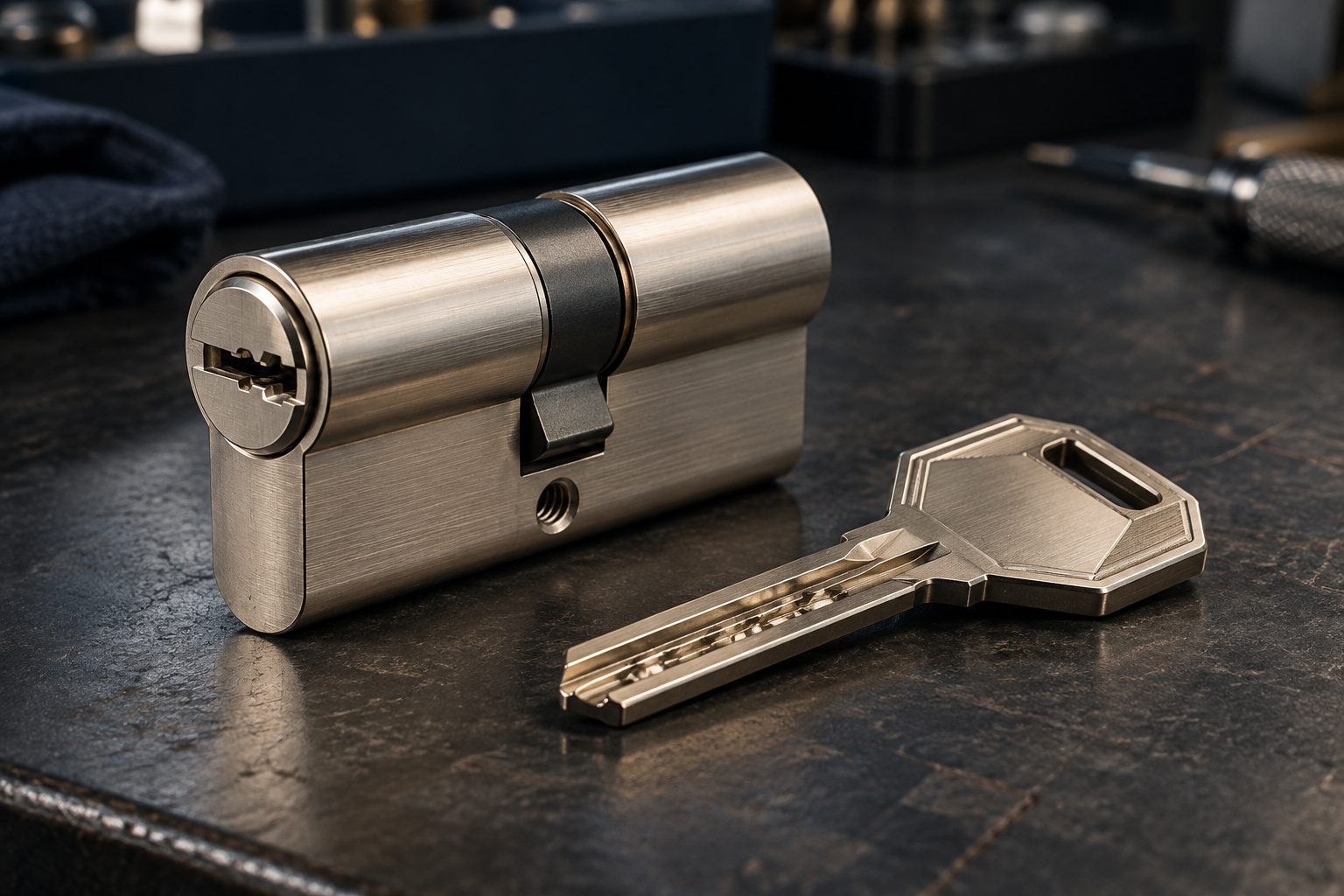
High security is one of the most abused words in the hardware business. It gets printed on packaging for locks whose only distinguishing feature is a heavier bolt and a brass finish. A genuine high security cylinder does three separate things at once: it resists manipulation, it resists physical attack, and it controls key duplication. Hardware that does only one or two of those is better than nothing and is not high security, and the third element is the one buyers most often overlook because it is invisible.
The third element is also the one that matters most in practice. A superbly engineered cylinder on a keyway anyone can buy blanks for still leaves you unable to answer the question of how many working keys exist. That question is the actual security problem in a multi-tenant office in Doral, a medical suite off Kendall Drive, a jewelry business Downtown, a restaurant with seasonal staff on Ocean Drive, or a condominium tower where management, staff and residents all need defined levels of access.
24/7 Locksmith Miami specifies, supplies, installs and services high security cylinders and restricted key systems across Miami-Dade. This page explains how these locks actually work, what each defensive feature defeats, how restricted and patented keyways function, where high security is the wrong purchase, and what it costs you in convenience. Call (786) 539-3980 to discuss what you are actually trying to protect, because that determines the specification more than the hardware catalogue does.
Standard pin tumbler cylinders open by picking because manufacturing tolerances mean the chambers are not perfectly aligned. Applying light rotational tension binds one pin first, and setting that pin at the shear line lets the plug rotate microscopically and bind the next, so the lock can be opened one pin at a time. Everything a high security cylinder does against picking is aimed at breaking that sequence or making its feedback unreliable.
Spool, serrated and mushroom driver pins are the first line. Their shaped profiles catch at the shear line and produce a false set, where the plug rotates slightly and the lock feels open while it is not, forcing a picker to unwind and start again. Tighter machining tolerances reduce the binding order's clarity. Many designs add a sidebar: a bar that must retract into a second set of elements, finger pins, a milled side track or rotating discs, before the plug can turn at all, so setting the main pin stack accomplishes nothing on its own.
Picking is the elegant attack and drilling is the common one. Drill resistance comes from hardened steel inserts placed where a bit would need to travel: hardened pins in the driver stack that spin rather than cut, hardened rods running through the shell along the shear line, and hardened plates behind the face. A bit that meets a free spinning hardened insert stops making progress and often destroys itself, which turns a quiet two minute attack into a noisy prolonged one.
The other physical attacks are plug pulling, where a screw is driven into the keyway and the plug extracted bodily, and twisting, where the plug is forced past its retaining components. Resistance comes from anti pull geometry, hardened retainers and cylinder designs where the plug cannot be extracted without destroying the housing. On the lock body rather than the cylinder, a saw resistant bolt with a hardened roller pin and a reinforced strike complete the picture. A drill resistant cylinder in a weak lock body on a weak strike still fails at the weak point.
Bump keys are cut to maximum depth on every position and struck while light tension is applied, transferring energy through the bottom pins to the drivers so they jump above the shear line momentarily. It works on a great many standard pin tumbler cylinders and it requires little skill, which is why it became a public concern. The defences are specific rather than general, and a lock marketed as bump resistant without any of them is marketing.
Security driver pins interrupt the clean energy transfer and catch at the shear line. Sidebars are largely immune, because jumping the main pin stack does nothing when a second independent element still blocks rotation. Designs where the key must lift elements in more than one plane, or rotate discs rather than lift pins, do not respond to the technique at all. Trap pins and sprung sidebar components add further resistance. In practice, a cylinder with a genuine sidebar and security drivers is not a bumping target.
Key control is the part people skip and the part that usually matters most. On a standard keyway, blanks are sold openly and anyone holding a key can have copies cut at any counter without question or record. However good the cylinder is, you cannot answer how many working keys exist. Restricted keyways solve this by controlling blank distribution: blanks are supplied only to authorized channels and duplication requires documented authorization against a signature card or an authorized user list.
Patented keyways add legal protection to the practical one. While the patent is live, the blank profile cannot be lawfully manufactured by third parties, which keeps unauthorized blanks out of circulation rather than merely making them inconvenient. That has an end date, and a keyway whose patent has expired retains its mechanical qualities while losing its exclusivity. It is a reasonable question to ask about any system being proposed, alongside who holds the authorization card and what happens if that person leaves the business.
Hardware is graded by standardised testing, and the grades describe different things. Operational grading measures cycles, strength and finish endurance, and is why Grade 1 hardware belongs on a door cycled hundreds of times a day while residential grade hardware belongs on a house. Separately, cylinders can be tested against attack, with ratings that reflect how long a cylinder resists specified picking, drilling and forcing attempts under test conditions.
Neither number tells you anything about key control, which is not a mechanical property and is not captured by attack testing. This is exactly why hardware can be genuinely excellent and still leave the underlying problem unsolved. The useful way to read the specifications is as three independent axes: will it survive the traffic, will it resist attack for long enough to matter, and can anyone copy the key. A sensible specification addresses all three deliberately rather than buying the heaviest lock and assuming.
High security cylinders are available in interchangeable core formats, which combines attack resistance and key control with the ability to change an opening in seconds. A control key retracts a lug and the figure eight core pulls out, and a pre pinned replacement drops in. For a property where a compromised opening needs changing immediately rather than scheduling, that capability is worth a great deal, and it is the standard approach in larger commercial portfolios.
Master keying a high security system is possible and requires more care than on a standard system. The extra shear line positions created by master wafers reduce pick resistance somewhat and consume usable combinations faster, and in a sidebar based system the side elements have to be charted alongside the pin stack. A properly designed system accounts for this from the start, deciding how many levels are genuinely needed rather than adding them as the building grows. Retrofitting levels onto a system that was not planned for them is where problems appear.
Multi-tenant commercial buildings are the clearest case, because tenants change, keys circulate and a landlord needs a master that stays trustworthy. Doral's warehouse and bay building stock and Downtown's office floors are full of exactly this. Businesses holding stock worth stealing, which in Downtown means the Jewelry District and in every neighbourhood means pharmacies, dispensaries, electronics and tool inventories, need the attack resistance as well as the control.
Medical and professional offices holding records have obligations that make undocumented key duplication a genuine liability rather than an inconvenience. Condominium towers use restricted systems across Brickell, Aventura and Sunny Isles Beach so that management keeps defined access while a lost unit key does not become a building problem. Residentially, the strongest case is a house where keys have circulated widely, where a previous owner's history is unknown, or where a specific opening such as a home office, a safe room or a firearm storage area needs genuine control.
The most common mistake is buying a high security cylinder for a door that fails somewhere else. A hollow slab, a wood jamb with a shallow strike and short screws, a sidelight within arm's reach of the thumbturn, a sliding glass door on the same wall, or an unsecured window beside the entry all mean the lock is not the weak point and improving it changes nothing. Assess the whole opening before upgrading one component of it.
It is also wrong where nobody will live with the consequences. A restricted system requires someone to hold the authorization and manage duplication requests, and a business that will not do that ends up with a system nobody can get keys for. It is wrong where key control is already handled better by electronic credentials that can be revoked instantly. And it is wrong on an opening that is going to be replaced anyway, where the money is better spent on the assembly than on a cylinder that will be discarded with it.
The convenience cost is real and worth accepting deliberately. You cannot get a spare cut at a hardware counter on a Saturday. A duplicate requires going through the authorized channel with documented authorization, which takes time. If you lose the authorization card or the person holding it leaves, that has to be resolved before anyone gets another key. Replacement cylinders come through the system's channel rather than off a service vehicle, which matters on an after hours emergency.
The management practices that make it work are simple and usually ignored. Keep a written record of every key issued, to whom and when. Require keys back and record their return. Keep one spare of each key somewhere secure and offsite rather than none. Decide in advance who may authorize duplication and document it. Review the list annually. A restricted system run without these is just an expensive lock, because the control it provides exists in the record keeping as much as in the brass.
High security cylinders cost multiples of standard ones, and the system around them carries its own cost: design and charting if master keying is involved, control keys, pre pinned spare cores if you want instant change capability, and the ongoing cost of authorized duplication. The number of openings drives it more than anything, and the honest scoping question is which openings genuinely need this specification rather than defaulting to all of them.
Before committing, do two things. Walk the property and list every opening, then mark which ones actually protect something and which ones are protected by another layer anyway. Second, work out what your key control problem actually is. If the problem is that keys walk out with departing staff, interchangeable cores may solve more than cylinder upgrades. If the problem is that a door has been attacked, drill resistance is the priority. If it is both, the specification addresses both, and it is worth talking through before hardware is ordered.
High security is one of the most abused words in the hardware business. It gets printed on packaging for locks whose only distinguishing feature is a heavier bolt and a brass finish. A genuine high security cylinder does three separate things at once: it resists manipulation, it resists physical attack, and it controls key duplication. Hardware that does only one or two of those is better than nothing and is not high security, and the third element is the one buyers most often overlook because it is invisible.
The third element is also the one that matters most in practice. A superbly engineered cylinder on a keyway anyone can buy blanks for still leaves you unable to answer the question of how many working keys exist. That question is the actual security problem in a multi-tenant office in Doral, a medical suite off Kendall Drive, a jewelry business Downtown, a restaurant with seasonal staff on Ocean Drive, or a condominium tower where management, staff and residents all need defined levels of access.
24/7 Locksmith Miami specifies, supplies, installs and services high security cylinders and restricted key systems across Miami-Dade. This page explains how these locks actually work, what each defensive feature defeats, how restricted and patented keyways function, where high security is the wrong purchase, and what it costs you in convenience. Call (786) 539-3980 to discuss what you are actually trying to protect, because that determines the specification more than the hardware catalogue does.
Upgrading to a high-security cylinder works best as a sequence of small decisions rather than one big purchase. Start by listing the doors that matter most: the main entrance, a back door, a storage room, or a garage entry. Then note what protects each one now, such as the lock type, the strike, and the door frame. A strong cylinder in a weak frame is a missed opportunity, so looking at the whole door comes first. A technician can help you see which parts are weak and which are sound.
Next, decide how many keys you need and who will hold them. High-security systems often use restricted key blanks, which are controlled so that copies cannot be cut casually. That is a benefit, but it also means a replacement takes more steps than a quick copy. Make a list of the people who need access, and plan for any who may leave or change roles. Some customers choose to number their keys and record who holds each one, which helps with later decisions about rekeying.
Then think about installation. The existing hardware has to accept the new cylinder, and the door has to be prepared properly. A technician checks the bolt throw, the strike alignment, and the way the door closes, since a high-security cylinder will not help if the door does not latch squarely. The scope and any quote are explained before work begins, and you can ask about alternatives. Call us to confirm availability, and describe your doors so the dispatcher can explain what is typically involved. Ask the technician to repeat anything that is unclear, because a plain explanation at the door is part of the service and takes only a moment.
This service is available across all of Miami-Dade County, see our full coverage map or just call and tell dispatch where you are.
One number, any hour: a live dispatcher and a mobile technician near you.